日本神社婚礼全攻略
Weddings 8 min read

日本神社婚礼全攻略

What Is a Shinto Shrine Wedding (神前式)?

A Shinto shrine wedding, known in Japanese as 'shinzen shiki' (神前式), is a traditional Japanese ceremony performed in the sacred space of a Shinto shrine (jinja). The ritual is conducted in the presence of the kami — the divine spirits believed to reside in the shrine — and is officiated by a Shinto priest (kannagi or kannushi). Unlike Western church weddings, the ceremony is not primarily about public vows to guests; it is a sacred offering and oath made before the gods, witnessed by close family members. The tradition became widely popular after the 1900 wedding of Crown Prince Yoshihito (later Emperor Taishō) was conducted in a Shinto style at the Imperial Palace. Before that, wedding ceremonies were typically held at home. Today, roughly 20–30% of Japanese couples who hold a formal wedding ceremony choose the Shinto style, making it the most popular traditional format. For international couples, a Shinto wedding offers a deeply authentic and visually stunning alternative to Western-style weddings. Many famous shrines — including Meiji Jingu in Tokyo, Itsukushima Shrine in Hiroshima, and Fushimi Inari in Kyoto — conduct ceremonies for non-Japanese couples, though policies vary by shrine. The ceremony is entirely in Japanese, which adds to its cultural atmosphere and can be followed with a printed bilingual program for guests.

Tip: Ask your wedding coordinator for a bilingual order-of-ceremony card (式次第) so your international guests can follow along in real time.

The Structure of the Ceremony: Step by Step

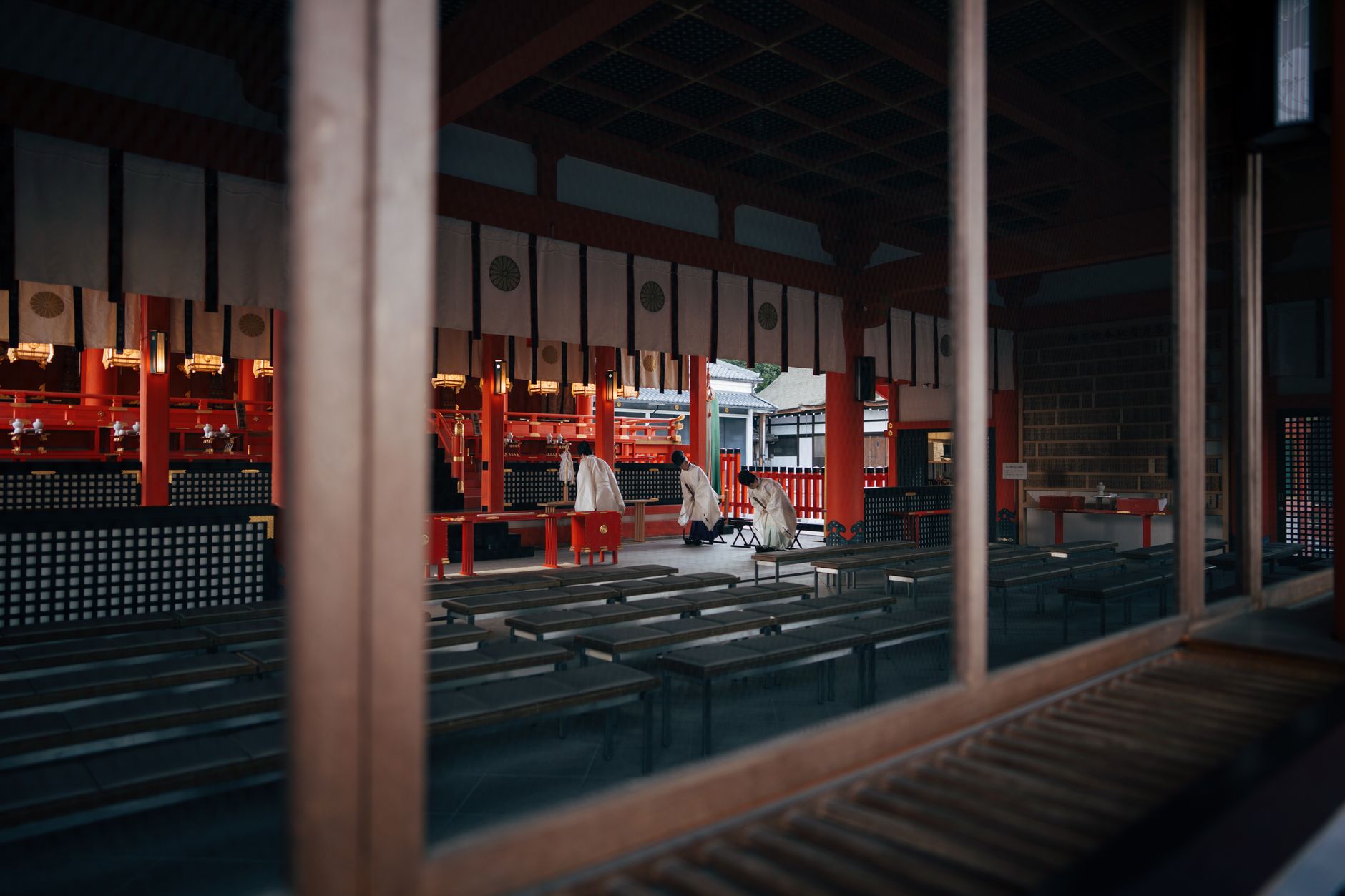
A full Shinto ceremony typically lasts between 30 and 60 minutes and follows a set sequence of rituals. It begins with the 'shubatsu' (修祓), a purification rite in which the priest waves a haraegushi — a wooden wand adorned with white paper streamers — over the couple and guests to cleanse them of impurity before entering sacred space. Guests are expected to bow respectfully during this portion. Next comes 'kensen' (献饌), the offering of food and sake to the kami, followed by 'norito sojo' (祝詞奏上), the recitation of a norito — a formal Shinto prayer chanted by the priest in classical Japanese. The norito announces the marriage to the gods and asks for their blessing. This is often the most atmospheric part of the ceremony, with the priest's low, melodic chant echoing through the shrine hall. The most iconic ritual is 'san-san-kudo' (三三九度), literally 'three-three-nine times.' The couple takes three sips each from three increasingly large lacquered sake cups (sakazuki), sharing the drink to symbolize the union of two families and the couple's bond with the kami. This ritual is the ceremonial heart of the marriage. It is followed by 'yubiwa koukan' (指輪交換), the exchange of wedding rings — a modern addition not originally part of Shinto ritual but now widely incorporated — and 'tamagushi hoten' (玉串奉奠), the offering of a sacred sakaki branch by the couple at the altar. The ceremony closes with 'tessen' or 'tehai,' a reading of the wedding vows (誓詞奏上, seishi sojo) by the groom, and often the bride, before the altar. Finally, 'naorai' (直会) — a ceremonial sharing of sake among all participants — closes the sacred portion. Guests typically raise their cups for a toast to the couple under the priest's guidance.

Tip: Practice the san-san-kudo beforehand with your coordinator. Three small sips from each cup is the custom — it's fine to barely touch the sake to your lips on early rounds.

Traditional Wedding Attire: Shiromuku, Iro-uchikake, and Hakama

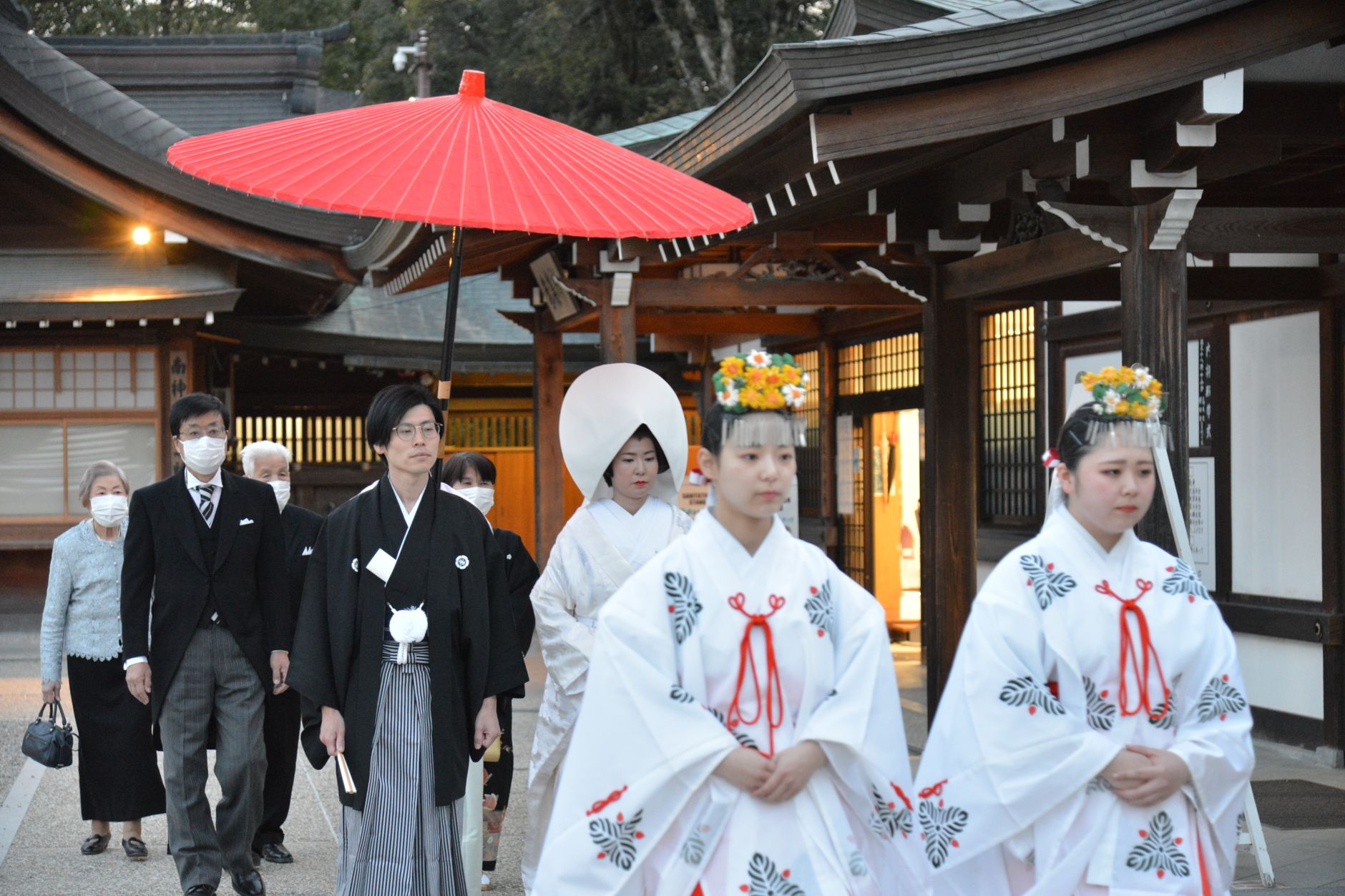
Traditional Shinto wedding attire is among the most elaborate in the world. For the bride, the classic choice is the 'shiromuku' (白無垢), an all-white layered silk kimono that symbolizes purity and the bride's readiness to take on the 'colors' of her new family. It is worn with a 'wataboshi' (綿帽子) — a padded white hood — or a 'tsunokakushi' (角隠し), a flat white headpiece, both of which symbolically hide the bride's 'horns of jealousy.' The complete bridal look, including a white or gold obi, 'shirakake' underrobe, tabi socks, and 'zori' sandals, is assembled over two to three hours with the help of professional kimono dressers. Many brides choose to change into a colored 'iro-uchikake' (色打掛) — a heavily embroidered over-kimono in red, gold, or other vivid colors — for the reception, a practice called 'oiro-naoshi' (お色直し). The transformation is a ceremonial highlight that guests anticipate. For the groom, the traditional attire is a 'montsuki haori hakama' (紋付羽織袴): a black or dark kimono bearing the family crest (mon), a formal haori jacket, and wide pleated hakama trousers, typically in charcoal or white. For international brides and grooms, full kimono rental and dressing services are available through most shrine wedding coordinators and bridal salons. Fittings typically take place one to two months before the ceremony. The weight and layers of a full shiromuku ensemble can be surprising — the complete outfit can weigh 8–12 kilograms. Most international brides say the experience of wearing it is worth every gram.

Tip: Book your kimono fitting as early as possible, especially if you have a non-standard size or height. Alterations to formal kimono take time and skilled hands.

Choosing Your Shrine: Famous Venues Across Japan

Not every Shinto shrine in Japan performs wedding ceremonies, and of those that do, many have traditionally restricted ceremonies to Japanese nationals or residents. However, this is changing, and a growing number of celebrated shrines now welcome international couples, particularly when working through a licensed wedding coordinator. Meiji Jingu (明治神宮) in Tokyo, one of Japan's most prestigious shrines, conducts weddings in its solemn inner precincts and is a popular choice for its grandeur and accessibility from central Tokyo. The processional walk through the forested path to the inner shrine is unforgettable. In Kyoto, options include the Heian Jingu (平安神宮), known for its vivid vermilion-and-white architecture and spacious gardens, and the Shimogamo Shrine (下鴨神社), a UNESCO World Heritage Site set in a primeval forest. In Hiroshima, Itsukushima Shrine on Miyajima Island — the famous 'floating torii' shrine — offers one of Japan's most dramatic wedding backdrops, with ceremonies timed to coincide with the tides. In Fukuoka, Dazaifu Tenmangu Shrine is another distinguished option. Shrines vary widely in size, atmosphere, guest capacity, and ceremony fees. Smaller regional shrines can offer intimate, uncrowded experiences at lower cost, while iconic venues carry both prestige and higher price tags. Some shrines work exclusively with designated wedding companies; others allow couples to bring their own coordinator. Always confirm whether the shrine accepts non-Japanese couples and whether a Japanese family member or resident is required to co-sign the marriage registration.

Tip: Visiting your shortlisted shrines in person before booking is highly recommended. The atmosphere you feel on a quiet weekday morning often tells you everything you need to know.

Costs and What's Included: Realistic Budget Guide

The cost of a Shinto shrine wedding in Japan varies considerably depending on the shrine, the region, and the coordinator you use. The shrine ceremony fee (玉串料 or 初穂料, tamagushiryō / hatsuhorvryō) typically ranges from ¥50,000 to ¥300,000, depending on the prestige and size of the shrine. This fee covers the priest's services, the ceremonial ritual, and use of the main hall (haiden). Meiji Jingu, for example, charges in the range of ¥100,000–¥200,000 for the ceremony itself. Beyond the shrine fee, major costs include kimono rental and dressing (¥100,000–¥400,000 for a full shiromuku package with accessories, hair, and makeup), photography and videography (¥150,000–¥500,000 for professional shrine coverage), and the wedding reception, which is often held separately at a nearby hotel or restaurant. A traditional kaiseki wedding reception for 20–30 guests at a Kyoto ryotei (traditional restaurant) can easily cost ¥500,000–¥1,500,000 in total. A grand reception at a top Tokyo hotel ballroom for 80 guests may reach ¥5,000,000–¥10,000,000 or more. For international couples who want a smaller, legal, and meaningful experience, a 'sanzen' or simplified ceremony with only immediate family (10–20 guests), kimono dressing, photography, and a private dinner can be arranged for a total of approximately ¥700,000–¥1,500,000, including coordination fees. Full-package all-inclusive shrine wedding programs offered by specialist agencies typically start around ¥1,000,000 and scale upward with guest count and venue prestige.

Tip: Ask coordinators for an itemized written estimate early. Costs can escalate quickly with add-ons like flower cars, extra chanters, or extended photography. Set a clear budget ceiling before your first meeting.

Legal Marriage in Japan: What International Couples Must Know

The Shinto ceremony itself is a religious and cultural ritual — it does not by itself create a legally binding marriage under Japanese law. To be legally married in Japan, couples must submit a 'kon-in todoke' (婚姻届), a marriage registration form, to a Japanese municipal office (shiyakusho or kuyakusho). This is a civil process completely separate from the shrine ceremony and can be done before, on the same day, or after the religious ceremony. For international couples, both partners typically need to provide a 'Certificate of No Impediment to Marriage' or equivalent document (sometimes called a 'marriageability certificate') issued by their home country's embassy or consulate in Japan. Embassies have different requirements and fees; the US Embassy, for example, issues an 'Affidavit in Lieu of a Certificate of Legal Capacity to Contract Marriage,' while UK nationals need a Certificate of No Impediment. Processing times range from same-day to several weeks, so apply well in advance. Once the marriage is registered in Japan, it is generally recognized in the couple's home countries, though registration with your home country's vital statistics office or embassy is often required additionally. Some couples choose to register in Japan and then hold a complementary legal ceremony or filing at home. Your wedding coordinator and your embassy are your two most important resources for navigating this paperwork.

Tip: Submit your kon-in todoke a day or two before the ceremony if you want to be legally married before you walk through the shrine gates. Some couples find this adds emotional resonance to the ritual.

Seasons, Timing, and Practical Planning Tips

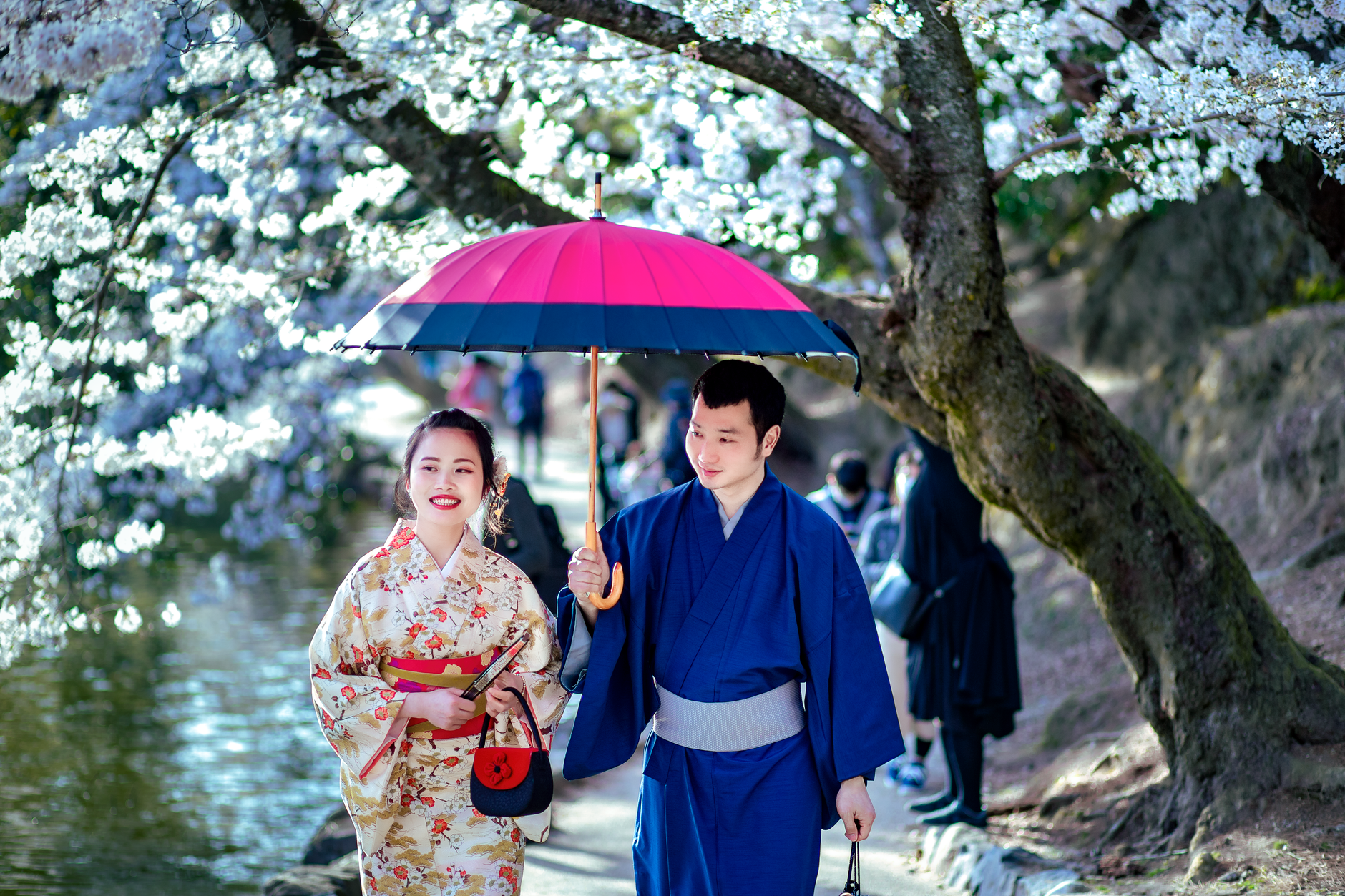
Shinto shrine weddings can be held year-round, but certain seasons are particularly beloved. Spring (late March through early May) is the most popular, with cherry blossoms (sakura) framing shrine pathways in pale pink — though this means competition for dates is fierce and some venues book 12–18 months in advance. Autumn (mid-October through mid-November), with its vivid maple foliage (koyo), is equally stunning and slightly less crowded than spring. Summer ceremonies can be extremely hot and humid, especially for brides in full shiromuku, but early mornings (many shrines conduct ceremonies from 9:00 AM) can be comfortable. Winter offers a serene, uncrowded atmosphere, and snow-dusted shrine grounds are breathtaking in northern regions like Nikko or Tohoku. Shrine weddings are not typically held on Buddhist memorial days (butsumetsu, 仏滅 on the traditional Japanese calendar) by superstition, and many shrine coordinators will steer you away from these dates. Conversely, 'taian' (大安) days — considered the most auspicious on the Japanese six-day cycle — book up fastest. Your coordinator can help interpret the ritual calendar when selecting your date. Start planning at least 12 months in advance if you have your heart set on a specific major shrine. Work with a Japan-based wedding coordinator who specializes in international couples — they will handle shrine liaison, legal paperwork guidance, vendor management, and bilingual communication. Many reputable coordinators in Tokyo, Kyoto, and Osaka offer international consultation via video call before you travel to Japan.

Tip: If your budget is flexible, consider a mid-week ceremony. Weekday dates at even the most popular shrines are significantly easier to secure and often feel more intimate and unhurried.